You can love the diamond in two rings and still feel completely differently about them. In one, the stone seems to float above a fine line of metal. In the other, a broad gold band is just as much a part of the attraction.
Engagement ring band width changes the balance of the design, how the ring feels on your hand and the space left for a wedding band. Start with the look you like, then check what those proportions mean in millimetres.
What does engagement ring band width mean?
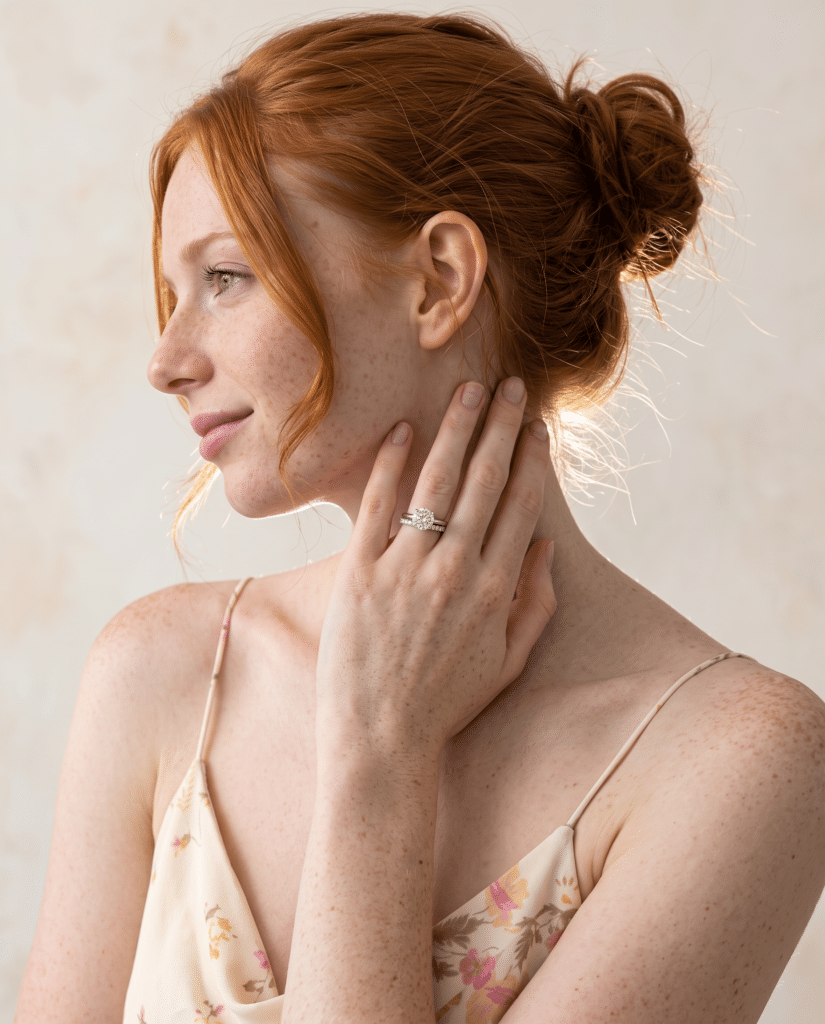
Band width is the distance between the band’s edges, measured along your finger when you wear it. It is usually given in millimetres. Try 2mm, 3mm and 4mm bands to see how a small change affects the ring’s proportions.
Lily Arkwright’s engagement rings for women include useful examples at both ends of the scale: the fine-band Grace solitaire and the 4mm Regent. Grace lists band widths of 1.65mm, 1.90mm or 1.95mm depending on the centre stone’s size. Both use a single round diamond, but the amount of visible metal gives them quite different silhouettes.
Check the measurement for the exact version you are considering. A band described as “tapered” changes width, so ask where the measurements were taken. The metal beside the stone may be much finer than the band beneath your finger.
Thin vs wide bands: how the diamond looks
As GIA explains, a thin band can make a diamond look larger by comparison. A wider band brings more metal into view, giving the whole ring a bolder outline.
That extra metal might be precisely what appeals. If you enjoy a substantial watch or a smooth gold cuff, try a broad, plain solitaire. It can have the presence of statement jewellery without adding more stones. A slim band gives the diamond more visual separation from the metal around your finger.
Compare similar centre stones in the same metal colour before deciding which width you prefer. Look at their visible dimensions, rather than carat weight alone, and avoid judging from product images enlarged to different scales. Otherwise, you may be responding to a bigger diamond rather than a different band.
Band width and thickness are different measurements
A band can look broad from above while sitting quite close to the finger. Another can look narrow but have a deeper, rounded profile. Width is measured along your finger; thickness or depth describes the metal between its inner and outer surfaces.
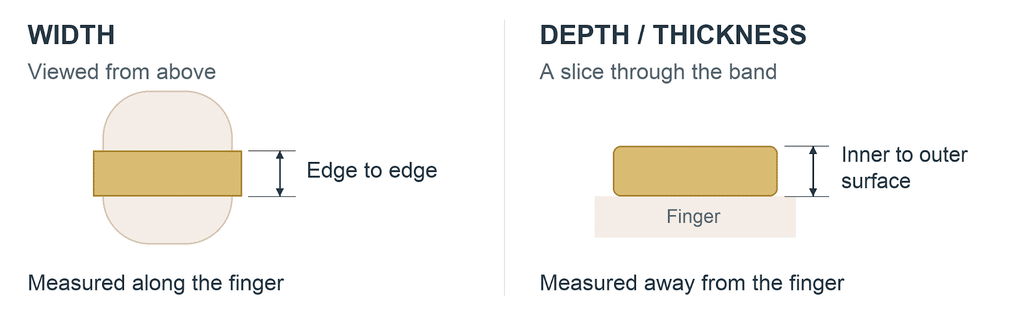
Schematic illustration, not to scale. The stone and its setting are omitted.
Ask to see the ring from the side as well as above. If a listing uses “thickness” without explaining the measurement, ask which dimension it means. The height of the centre-stone setting is a separate detail again.
Width alone is not a durability rating. Ask the jeweller whether the full design suits your daily routine, especially if you want a very fine band or plan to change its dimensions.
Check how a wider engagement ring fits
Try the width you intend to buy when having your finger measured. GIA’s ring-sizing guidance notes that wide bands generally fit more snugly, so the size of a narrow ring you already own may not transfer directly.
Give yourself more than a quick look in the mirror. Relax your hand, bend your fingers and notice where the edges sit. If the band presses uncomfortably against neighbouring fingers, describe that to the jeweller and try another profile or width as well as checking the size.
Try the engagement ring with a wedding band
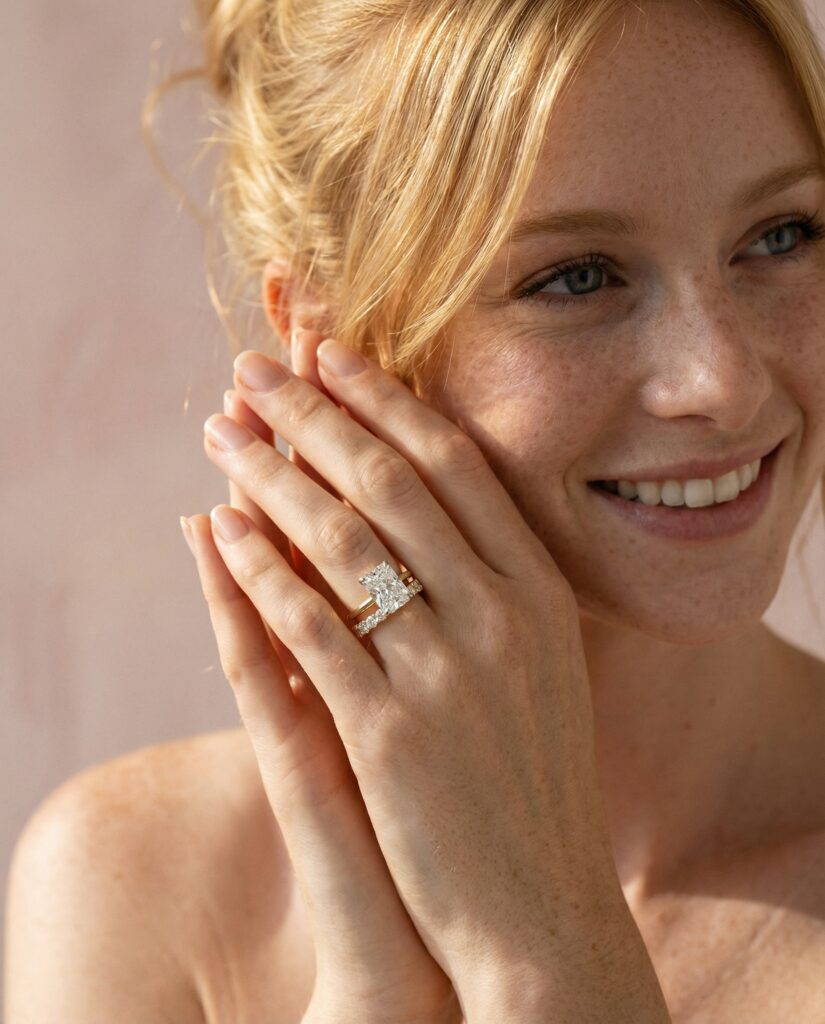
If you plan to wear both rings on the same finger, try the combination before settling on the engagement ring. As a simple illustration, a 2mm band beside a 3mm band gives you roughly 5mm of combined width before allowing for any gap. That can feel quite different from either ring alone.
The two bands do not have to match. A wider plain wedding band can give a delicate solitaire a stronger outline, while a finer wedding band can leave a broad engagement ring in focus. Check that the settings allow the rings to sit together comfortably and ask about any contact between them.
Wear each ring separately too. You might love the pair but also want a wedding band that feels complete on the days you wear it alone.
Choose the proportions you want to wear
Before ordering, look at the ring with your usual watch or favourite bracelet, then with no other jewellery. Check whether you still enjoy the balance when you see your whole hand.
If you are still torn, try an intermediate width. Moving from 2mm to 3mm may give you the extra visible metal you wanted without going as broad as 4mm. You do not have to choose between the two extremes in your saved photographs.